
"The Granary"
Français
Italiano
Español
|
|
"The Granary" |
English
Français Italiano Español |
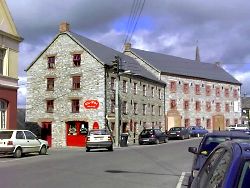
The Granary building, located in Church Street, was built in the nineteenth century, as part of the improvements of Lord and Lady Cahir. Lord Cahir was a trustee of the Lined Industry, and in 1809, under the auspices of the newly formed Cahir Local Association, a linen factory was established here. In November 1820, through the sponsorship of Lord Glengall, 180 spinning wheels were installed, and a spinning school was begun in the building for the conversion of flax into linen. An Annual grant by Lord Glengall expanded the industry, and a weekly market for the sale of linnen and yarn was established on October 10th. 1823. This all took place in that half of the building nearest the Post Office. The bleaching of linen was also carried out behind this building, and this area became known as the bleach Green.
By the mid 1840's linen manufacture had declined, due to a decrease in markets. As in many areas of the south corn milling and flour production became the trade of town and district. The building was considerably enlarged, and it was at this point that the part housing the Regional Crafts Centre was built. One part of the enlarged building was leased to Richard English for his corn-milling business, (hence the Granary name) and the other part to Samuel Burke & Co., as a General Store. The building continued to be used for various adaptations of this type of business throughout the 20th century, until it was gutted by fire in 1985.
Since restoration, it displays some exemplary stonework and contributes much to the streescape of the town. Most appropiately, one half of this listed building contains the South East Regional Craft Centre - the only one in the country to incoporate space for training, production and sale of crafts under one roof.